

 English
 Español
 عربى
 Tiếng Việt
NEWS

Industry
 By Admin
Improving Sewing Stability with Proper Anti-Slip Elastic Band Selection
In garment manufacturing, elastic components need to maintain their position throughout cutting, sewing, assembly, and everyday use. When an elastic band shifts during sewing or fails to stay in place after installation, it can affect garment appearance, fit, and production efficiency. Anti-Slip Elastic Band offers a practical option for applications that require additional surface grip. For apparel factories, fabric wholesalers, and textile product developers, understanding how grip structure, sewing compatibility, and elastic recovery work together helps prevent avoidable production problems.
Preventing Elastic Movement During Garment Assembly
One common problem in garment production is elastic displacement during sewing. When the material moves against the fabric, workers may need to adjust its position repeatedly, resulting in uneven stitching or inconsistent garment dimensions.
The risk can increase when working with lightweight fabrics, curved garment sections, or elastic components with smooth surfaces.
To address this issue, manufacturers should consider:
- Surface friction between the elastic and garment fabric.
- Appropriate elastic width for the sewing area.
- Compatibility with the selected stitching method.
- Consistent feeding and tension during machine operation.
A suitable anti-slip structure can help maintain positioning and make garment assembly more manageable.
Silicone Patterns and Their Practical Functions
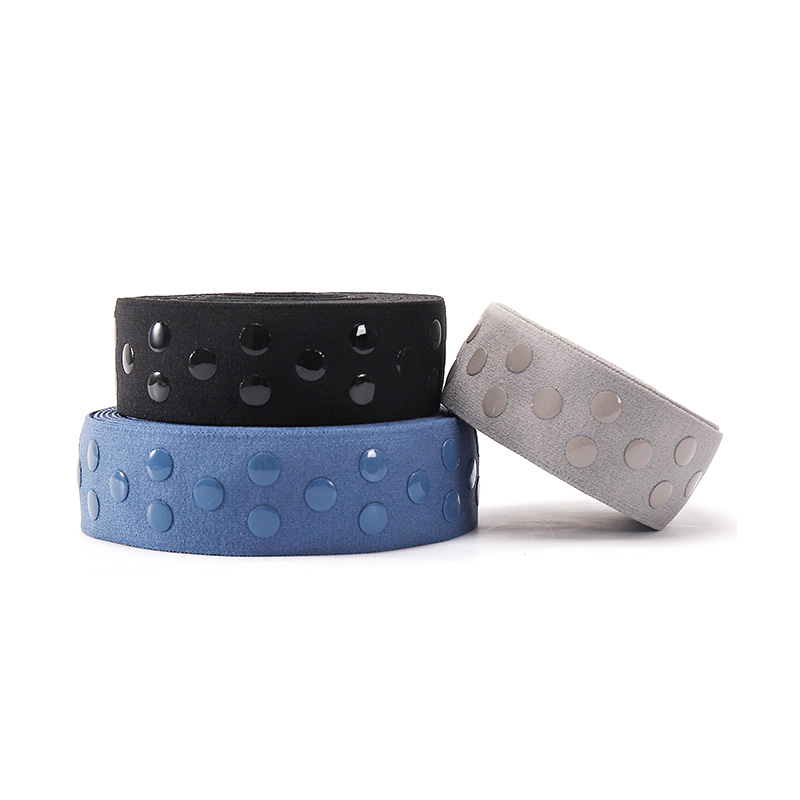
Silicone-coated elastic bands are widely considered for garments that require additional grip. Their surface patterns create contact points that help reduce unwanted movement between the elastic and surrounding materials.
Different pattern designs serve different product requirements. Continuous silicone lines may suit applications requiring relatively consistent contact, while separated patterns can offer flexibility in surface coverage.
When developing a customized product, buyers should evaluate the silicone distribution, coating adhesion, and flexibility. Excessive coating coverage may affect the hand feel or bending characteristics, so the design should match the intended application rather than simply focusing on grip.
Maintaining Elastic Recovery After Repeated Stretching
Grip alone does not determine whether an elastic band performs well. Recovery is equally important, particularly in garments that undergo frequent stretching during dressing, movement, and washing.
If an elastic band loses its original shape, the garment may become loose or fail to maintain its intended fit.
Manufacturers should pay attention to:
- Elastic yarn quality and material composition.
- Stretching performance under normal use.
- Recovery after repeated extension.
- Consistency between samples and bulk production.
Testing these properties together provides a clearer picture of how the material will perform in finished garments.
Matching Elastic Specifications to Fabric Types
Different fabrics interact with elastic surfaces in different ways. Smooth synthetic fabrics, cotton blends, knitted materials, and stretch textiles may require different grip structures and elastic tensions.
For example, sportswear often requires a combination of flexibility and surface grip to reduce movement during exercise. Underwear manufacturers may prioritize a softer contact surface, while fitted uniforms may require stable positioning around waistbands or garment openings.
When requesting samples, buyers should provide fabric swatches whenever possible. This allows manufacturers to assess material compatibility under conditions closer to actual production.
Avoiding Common Problems with Silicone Adhesion
Silicone adhesion is another important consideration when purchasing anti-slip elastic materials. If the silicone layer does not bond properly with the elastic base, it may peel, crack, or become uneven during processing and use.
Quality inspections should therefore include:
- Checking whether the silicone pattern is evenly applied.
- Examining the bonding between silicone and elastic material.
- Observing surface changes after repeated stretching.
- Evaluating resistance to normal washing conditions.
These checks help buyers identify potential coating problems before placing larger production orders.
Customization for Different Garment Requirements
Textile buyers often need elastic bands that match specific garment designs and manufacturing processes. Customization may involve material selection, width, color, thickness, silicone pattern, and packaging.
For manufacturers, understanding the final application is essential before confirming specifications. A waistband for activewear may require different stretch and grip characteristics from elastic used in lingerie, socks, or fitted uniforms.
We recommend confirming the intended fabric, sewing process, and performance expectations during sample development. This makes communication between suppliers and garment factories more efficient.
Supporting Consistent Results in Bulk Production
For wholesale distributors and apparel manufacturers, product consistency is just as important as sample performance. Variations in elastic tension, silicone placement, or material dimensions can create difficulties when processing large fabric batches.
A clear specification sheet and production inspection procedure help control these differences. By evaluating grip, stretch recovery, coating adhesion, and sewing compatibility together, buyers can make more informed sourcing decisions.
Choosing the right Anti-Slip Elastic Band is ultimately a matter of matching material performance with real garment production needs. As a manufacturer, we focus on these practical requirements during material selection, sample evaluation, and production quality control, helping textile buyers source elastic components suited to their applications.

-
Tel:
+86-18767935551
+86-18395959909
+86-18767935551
-
Email:
saijia@sjelasticband.com
claiejin@sjelasticband.com
luffy@sjelasticband.com
-
ADD:
3F, Building 6, No.151, Huasheng Road, niansanli Street, Yiwu City, Jinhua City, Zhejiang Province, China.
LEAVE A REQUEST
AND WE'L CONTANT YOU.
AND WE'L CONTANT YOU.
Copyright © Yiwu Saijia Garment Accessories Co., Ltd. All rights reserved.
Custom Elastic Bands
